




Ithaki: I Pray Your Road Is a Long One

Floating in the waters of Zakynthos, an Ionian island near Ithaka.
I’m bouncing between ChatGPT, Expedia, and Fareboom, trying to understand how I actually fly from Tampa to Cape Town, South Africa. I’ve realized there are at least two long-haul flights back to back that I must take to get there. There is no direct flight from Atlanta or Miami all the way to Cape Town on the dates I need to go, which means a couple of connections and all the risks that come with them: delays, missed planes, lost luggage, and long layovers.
This is nothing new. When I was a young woman, I found every trick that existed, long before ChatGPT, to get to Europe as cheaply as possible, no matter the inconvenience. I had a family of six to buy tickets for, and every $100 saved meant more money for the trip and less money spent on the flight over, which was going to be hell with small children anyway, no matter the route. I once flew Aeroflot all the way to Moscow just to flip a cookie and fly back to Greece. I have taken charters on separate tickets out of JFK and personally schlepped all of our bags through the airport to recheck them both ways just to save money. At one time or another, I think I flew every obscure airline that existed, and most of them are no longer in business.
As I have gotten older and moved closer to my finish line in life, direct routes, comfort class or business class, and efficiency have become the new priority. I have learned that the more direct the route, the fewer opportunities there are for something to go wrong. Fewer plane changes mean fewer delays and missed flights, fewer unexpected overnights in strange cities, missing luggage, creepy airport hotels, and subpar meal vouchers. I also learned that no matter what deal was offered, I should stay away from United Airlines and Newark Airport. For me, they became a vortex of late nights in customer service lines, shuttles down the New Jersey Turnpike, four hours of sleep, a 5 a.m. wake-up call to head back to the airport, only to discover another cancelled flight and a completely new route.
When I was younger, I didn’t mind the adventure or the inconvenience. These days, I avoid both when I can. After so many detours and roundabouts, I’m committed to fewer mistakes and better discernment. I’m much more comfortable saying no to opportunities. Shiny objects don’t entice me the way they used to. A lot of the bling looks cheap now.
When I was a child, I spent many hours sitting on my dad’s lap listening to his stories of Greek mythology. I heard the stories of Odysseus so many times that adventure, misfortune, favor of the gods, monsters, storms, and destiny became part of my lifeblood. My dad especially loved a poem called Ithaka, by Constantine Cavafy, inspired by Odysseus’s long quest to return home. It begins with the beautiful wish that as you set out for Ithaka, your road will be a long one, full of adventure and discovery.

My dad bought a sailboat when I was about eight years old and named it Ithaki. Whenever my mother complained about something taking longer than it should or about some inconvenience that annoyed her, my dad would simply say, “Ithaki.” Sometimes my mother would nod in agreement. Other times she would roll her eyes. Every mistake we made that taught us a lesson received the standard Ithaki lecture from my dad. Whenever he got us lost on a driving trip and my mother pulled out the map to get us back on track, my dad would tell her to put the map away. We weren’t lost. We were experiencing Ithaki.

At my high school graduation, I was honored to give a speech to my graduating class. Of course, I read from Ithaka. My dad and my Greek relatives sat proudly listening as I read the lines about keeping Ithaka always in your mind, but not hurrying the journey, because it is better to arrive old and wealthy with everything you have gathered along the way.
I didn’t realize how much I was prophesying over my own life. Maybe I didn’t even believe what I was saying. I certainly didn’t comprehend the depth of that wisdom or anticipate how convoluted, twisted, and circular my own journey would become.
Looking back now, with the strength, confidence, and wisdom Ithaki has given me, I can see how much more directly I could have traveled to where I am today. I spun my wheels and made oodles of mistakes. I trusted the wrong people, mistook detours for shortcuts, and stranded myself on islands of delusion. I fought plenty of Cyclops, many of them within myself, and I got caught in more than a few storms. But only now can I see that all those adventures gave me the experience to travel differently in my older years.
I have better discernment now. I recognize people who can’t be trusted much sooner. I know that a good-looking opportunity isn’t necessarily a good opportunity. I have less ego than I used to and I am far less impulsive. I know how to wait. I know how to walk away. I know that sometimes the thing that looks like the fastest route will cost you years. But there was no shortcut to learning any of this. The long journey gave it to me.

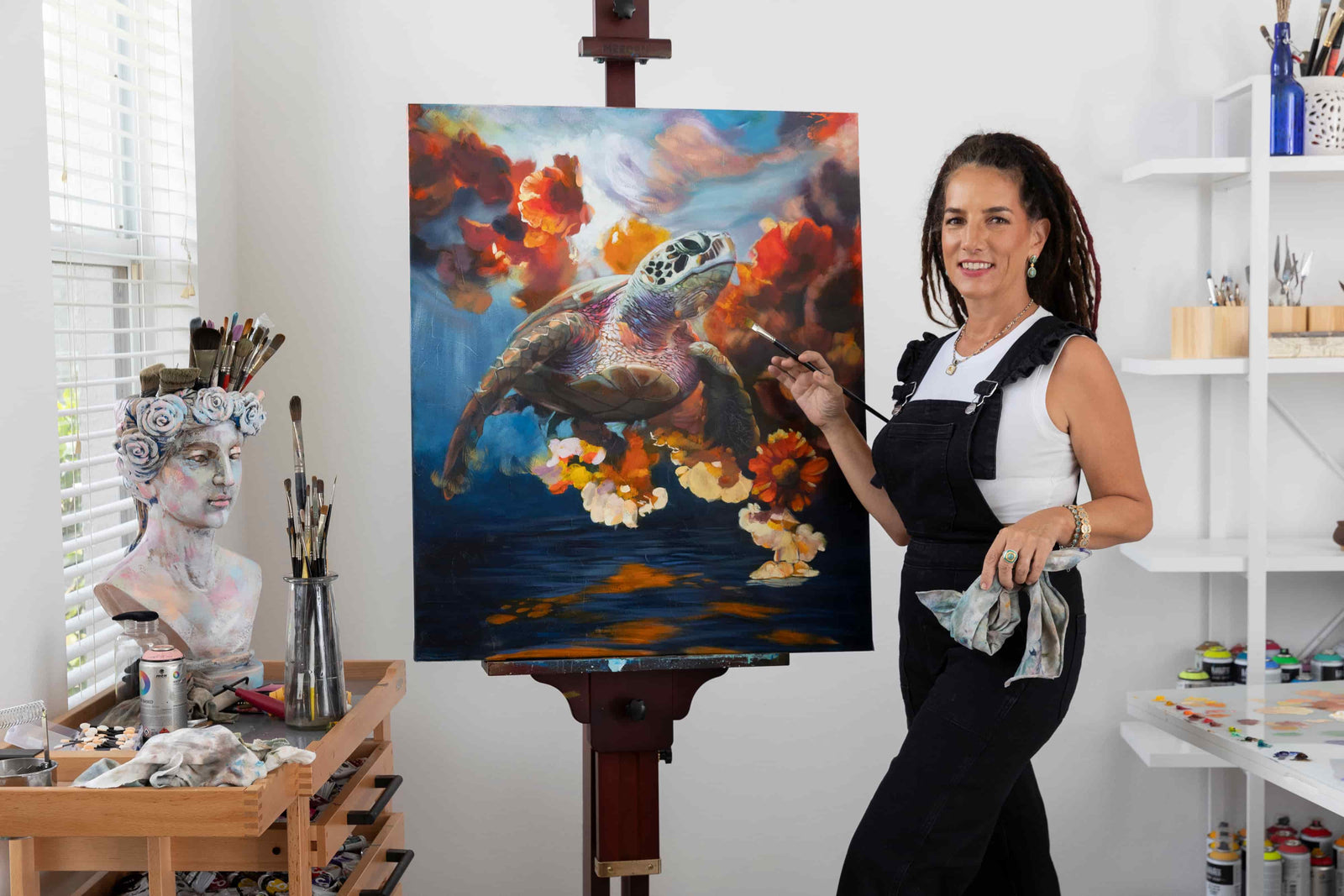
As artists, we can become so focused on the fruition of the dream. We want to become professional artists with a steady creative practice, prolific and abundant in our studios. We want hundreds of collectors and hundreds of thousands of followers. We want to see our names on the walls of well-lit galleries and our stories in print. We yearn for our art to shift culture, move someone’s heart, and affect change. We keep Ithaka always in our minds.
But then we participate in art shows that are a bust. We work with the wrong people. We spend years pursuing opportunities that lead nowhere. We get waylaid by self-doubt and lose clarity about what we are even trying to say. The road becomes long, with far too many twists and turns, and sometimes we feel lost, sometimes abandoned, sometimes certain we’ve been left for dead.
And yet, this is the journey that makes our mettle. The disappointments prune away what doesn’t belong, and the storms reveal weaknesses we could never see in calm water. The wrong people teach us to recognize the right ones, and failure sharpens our instincts in ways comfort never could. Waiting deepens us. Even the long stretches when absolutely nothing seems to be happening are doing something to us.
I am grateful now that I am older and can see the road shortening. Ithaka feels closer. I have far fewer doubts about my destiny and much more confidence that I will indeed arrive. But I also know that this confidence could never have been given to the younger version of me. She hadn’t earned it yet. She needed the storms, the wrong turns, and a few Cyclops. She even needed some of those terrible airport hotels.
Maybe that is why my dad loved the poem so much.
The older I get, the more I understand that Ithaka was never simply the destination. Ithaka was the reason to leave home in the first place. The destination pulled us forward, but the journey made us capable of arriving.
So if your artistic journey is taking much longer than you thought it would, don’t assume you have missed your destiny. If you find yourself in a season of small things, don’t despise it. If there is no wind in your sails and nothing seems to be happening, stay with the journey, keep making the work, and keep becoming harder to fool and easier to lead. Keep Ithaka in view.
Cavafy ends his poem with the realization that Ithaka has already given the traveler her gift. She gave him the marvelous journey. Without her, he never would have set out.
I think I finally understand what my dad was trying to tell us every time we got lost and he refused to let my mother look at the map.
We weren’t wasting time. We were becoming the people who could make it to Ithaka.
15 comments
Popular posts


Thank you so much for such an insightful story and how much it spoke to me as a person and an artist.
I love this! I often fret about not accomplishing what I want, painting to slowly, health issues, wrinkles, my body shape changing, “getting closer to the finish line,” etc. But one thing I wouldn’t give up for all of that is the experiences I’ve had along the way and the wisdom I’ve gained from them.
Thank you , amazing story ,at 80 , I know that this journey called life ,and all its ups and downs, is the shape that gives us our character, strengths and sometimes helps us find our weaknesses.
I love that your dad used Ithaca as his beacon . He sounds lovely. My dad was amazing and I was daddy’s little girl having 5 brothers. Then my sister came along when I was 11. , i was thrilled to have a sister , which when I look back surprises me now.
Your life has been so full and is still , you deserve success after your years of hard work. Much admiration!
I’m just beginning my exploration of art! With the help of you and your beautiful daughter.
I’m off to find Ithaca to read.
Thank you. Xx
———
Elli Milan Art replied:
That’s so exciting to start a new adventure! Good for you!!
Hi Elie: your blog is amazing and moves me each time I read it. This story reminds me a lot of my own journey and my Husband, also a sailor. His favorite saying for life was “you can’t control the wind, but you can adjust your sails.” Seemed fitting to share that here. Thanks for all you do. You are inspiring.
———
Elli Milan Art replied:
I love that!
I like the word Mettle. I have read books that test it. It is a privilege to follow your journey. Great words and thank you for taking the time to share with us.
Blessings,
~MinEO
———
Elli Milan Art replied:
Thank you!
Leave a comment